Digital Hifz Records: What a New Speech-Recognition Study Shows
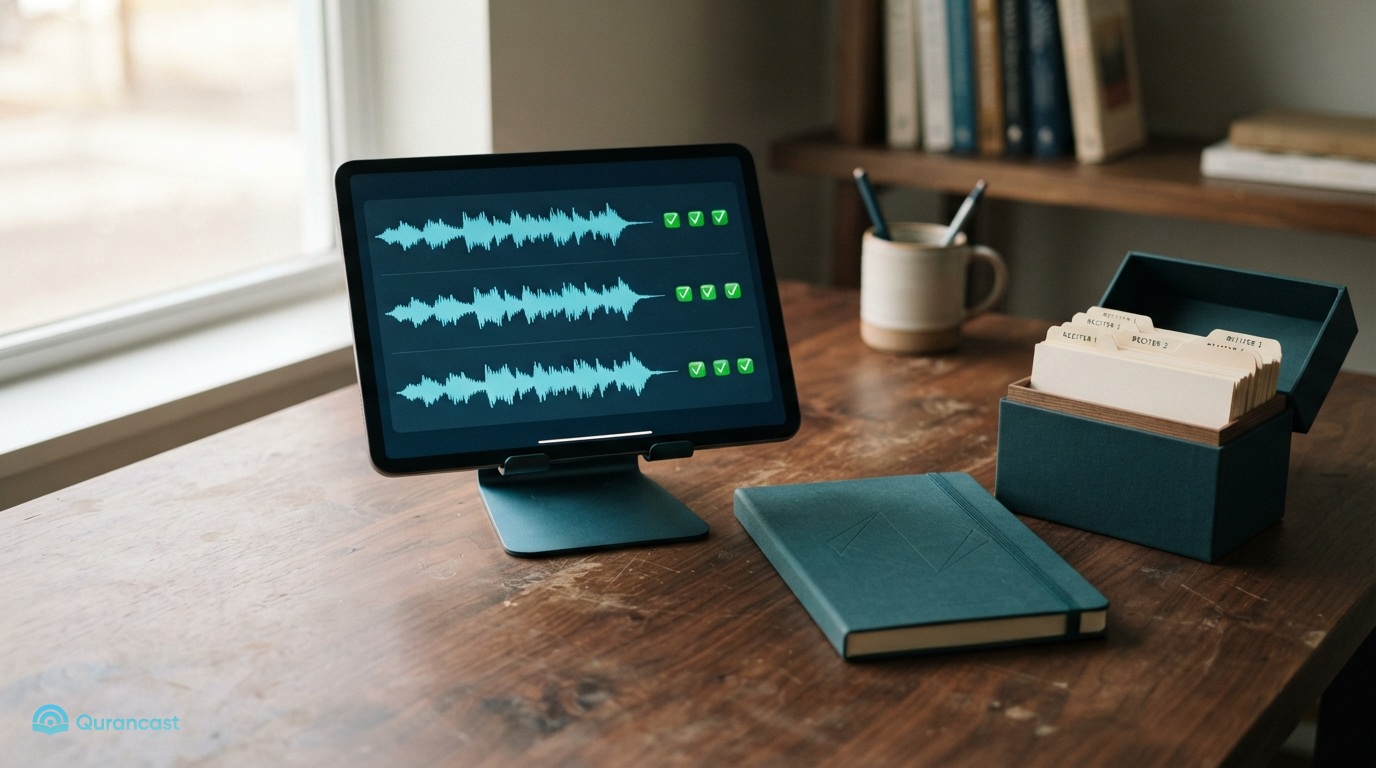
Technology can help huffaz maintain organised revision records, but a usable memorization app is not automatically an accurate judge of recitation. A study published on 30 September 2026 examines speech recognition for recording Quran memorization submissions, highlighting the distinction between convenient administration and dependable assessment.
This is research analysis based on the publisher's public abstract and publication record, not a claim that a new product has solved hifz assessment. The practical question is what a teacher can safely infer from an automated result.
What did the September 2026 hifz study build?
The researchers describe an application that combines speech recognition with Levenshtein Distance to compare a recognized recitation with its reference text. It produces a similarity score and supports recording memorization submissions. The stated aim is to assist teachers with assessment documentation, rather than remove the need to listen carefully to students.
Reihan Deirengga, Firdaus Annas, Riri Okra and Gusnita Darmawati report the work in Didactum: Journal of Educational Innovation and Learning Studies. The publisher lists their affiliation as Universitas Islam Negeri Sjech M. Djamil Djambek Bukittinggi. Their development method is Rapid Application Development, covering requirements, design and implementation.
Does the reported usability score mean accurate recitation?
No. The reported 93.41% is a usability questionnaire result involving 56 respondents, not a recitation accuracy rate. The abstract separately reports 100% for functional suitability and compatibility testing. Those results concern the evaluated software checks and user experience; they do not establish perfect recognition, complete Tajweed assessment or long-term memorization improvement.
The distinction matters when a number appears on a promotional card. A working button, compatible device and easy interface are valuable, but they answer different questions from whether a learner omitted a word or produced a sound correctly. We have not independently reproduced the study's tests or reviewed its full methods.
What can a text-similarity score miss?
A text-similarity score compares the transcript with reference text; it does not directly hear the original sound. Recognition errors can therefore enter before the comparison begins. Articulation, ghunnah and madd also require attention to pronunciation and timing. A close text match alone cannot certify that those features were correctly performed in the audio.
Levenshtein Distance measures the edits needed to turn one sequence into another. That can help locate differences, but an application still needs to distinguish an actual recitation error from an imperfect transcript. A repeated phrase may also require context rather than an automatic penalty. These are methodological cautions, not additional experimental findings reported by this study.
How can digital records support huffaz without replacing teachers?
Digital records can make it easier to retrieve a passage, its practice history and unresolved corrections before the next lesson. Their value is organisational: preserving a clear account of what needs review. A teacher should still decide whether a passage is secure and whether a flagged difference is an actual mistake or a recognition problem.
For readers new to structured revision, our Sabaq, Sabqi and Manzil guide explains how new learning and older memorization fit together. Software should support that routine rather than encourage learners to collect completed-session badges while neglecting difficult passages.
What should a trustworthy revision record contain?
A useful record separates what happened from what the software inferred. Keep the passage reference, date, practice aim and teacher-confirmed correction distinct from an automated suggestion. Where recording is appropriate and consented to, retain only the audio needed for review. Uncertain output should remain visibly uncertain rather than becoming a permanent learner label.
- Identify the passage and whether the attempt was reading, recall or review.
- Label automatic feedback as automatic, and teacher confirmation as confirmation.
- Record the next practice action, not only a percentage.
- Check consent, access and deletion arrangements before retaining recordings, particularly for children.
This checklist is our editorial recommendation, not a list of features verified in the research application. A tool should make it possible to resolve a disputed correction, not turn uncertainty into a misleading record of failure.
What evidence should families ask for before trusting an app?
Ask what was measured, on whose recordings and under which conditions. Usability, word recognition, Tajweed error detection and learning progress need different evidence. Look for real learner recordings, clear error definitions and qualified review. A promising prototype can support a trial, but its evaluation should not be stretched into a guarantee for every learner.
Useful follow-up questions include whether accents and recording noise were tested, how mistakes were labelled, and what happens when the recognizer cannot understand a passage. The public abstract does not settle all of these questions. See our guide to useful recitation feedback for a learner-centred review process.
Does this study validate QuranCast's performance?
No. This study evaluates the researchers' application, not QuranCast, and its results must not be presented as evidence of QuranCast's accuracy or learning outcomes. QuranCast by NEARFOLD (Dubai) offers AI-assisted practice; learners should treat automated feedback as support and take persistent or disputed corrections to a qualified teacher for individual review.
Explore the QuranCast AI teacher with that distinction in mind. For a broader discussion of limits, read what AI can and cannot do for Tajweed. This article does not claim institutional endorsement, certification or equivalence between competing products.
Can you practise on the web as well as mobile?
Yes. QuranCast is available through a web browser and its official Google Play and Apple App Store listings. Choose a convenient format, then test your microphone and the current practice controls. Availability across platforms is separate from research validation: the study discussed here does not establish performance on any QuranCast device or learning mode.
Open QuranCast on the web, Google Play or the App Store. The practical priority remains a sustainable review routine with a way to question and verify feedback.
Source checked on 9 October 2026: the linked publisher page, including its abstract and publication date. Statistics above are attributed study results, not independently verified product claims. No Quran verses are quoted or altered. Cover: AI-generated illustration, not a screenshot of the study application or QuranCast; the official logo was added separately.