Noorani Qaida to Quran: Your First Steps
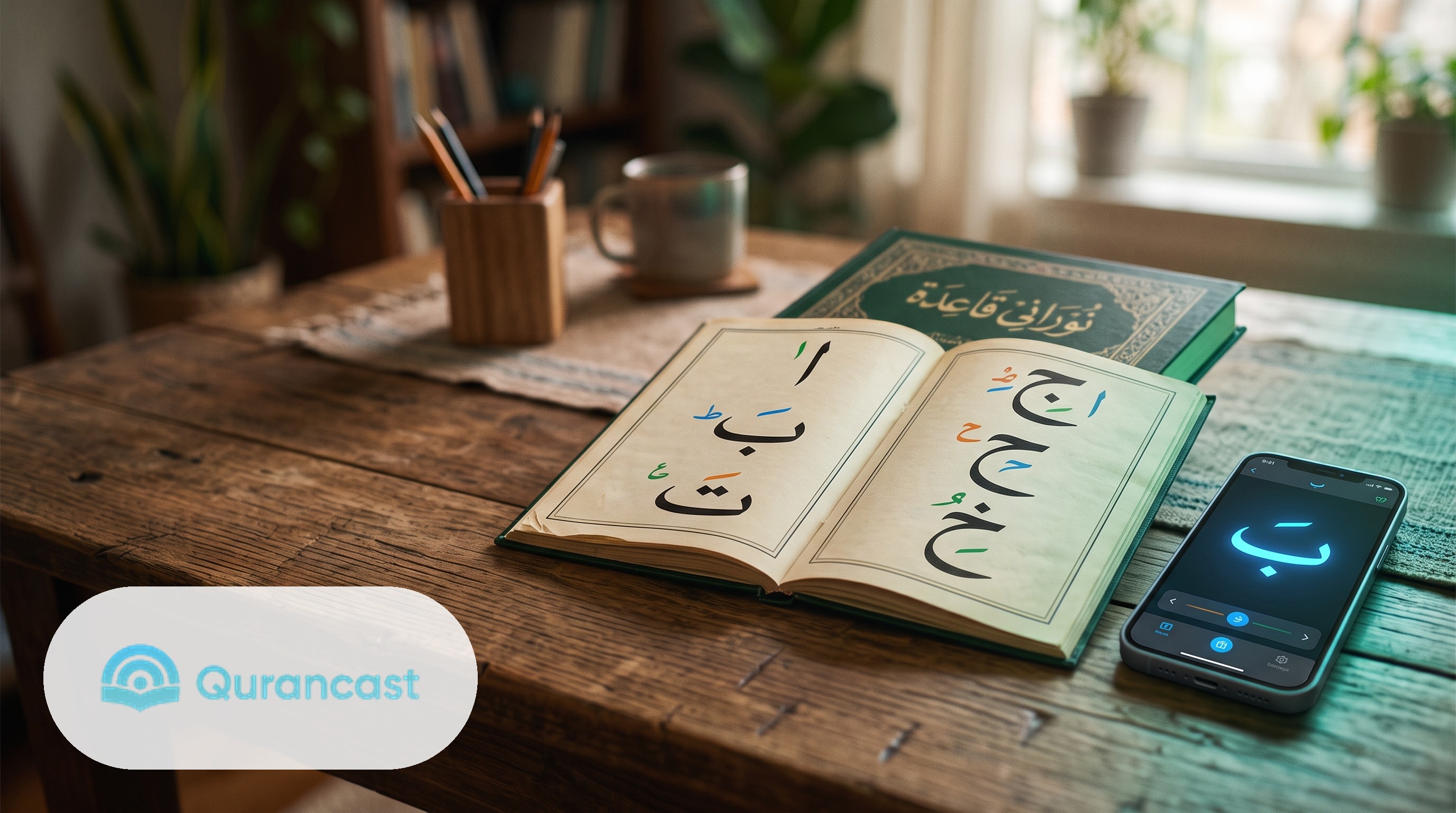
Every fluent reciter you have ever heard — every imam whose voice fills a mosque in Ramadan, every teacher whose students hang on every letter — began in the same place: staring at a page of disconnected shapes, learning that this curve is ب and that the small mark above it changes everything.
For most of the Muslim world, that first page belongs to a little booklet called the Noorani Qaida. It is not the Quran itself. It is the ladder you climb before you are ready to stand in front of it. This guide explains what the Noorani Qaida is, how it is structured, how long it realistically takes, and how to move from its final page to reading the Book of Allah with confidence.
What is the Noorani Qaida?
The Noorani Qaida is a graded primer for reading Arabic as it appears in the Quran. It was compiled by the Indian scholar Sheikh Noor Muhammad al-Haqqani, and it spread through the subcontinent and then the world precisely because it does one thing very well: it assumes you know nothing — not the alphabet, not the vowel marks, not even the direction of the script — and it builds you up one small, deliberate lesson at a time.
Its philosophy is simple. You do not start by reading verses. You start by mastering the sound of every letter, then letters joined together, then letters carrying the short vowel marks (the harakat), then the rules that make Quranic recitation distinct from ordinary Arabic reading. By the time you open the mushaf, the page is no longer a wall of unfamiliar symbols — it is text you can decode, sound by sound.
How the Qaida is structured
Editions vary slightly, but the classic progression moves through these stages:
1. The individual letters (al-huroof al-mufradah)
You learn the 28 letters of the Arabic alphabet one at a time, in their standalone forms: ا ب ت ث ج ح خ and so on. The emphasis is not on writing but on recognition and pronunciation — training the eye to tell ب from ت from ث (the same shape, different dots) and training the tongue to produce letters that have no equivalent in English, like ع (ayn), ح (haa), and ق (qaf).
2. Joined letters (al-huroof al-murakkabah)
Arabic letters change shape depending on where they sit in a word — beginning, middle, or end. This stage teaches you to recognise ب whether it appears as بـ, ـبـ, or ـب, and to read simple joined combinations.
3. The short vowels (harakat)
Now each letter meets the three short vowel marks: fatha (بَ = ba), kasra (بِ = bi), and damma (بُ = bu). This is where Arabic starts to sound like language rather than a letter drill. If you want a deeper tour of these marks, our beginner’s guide to Arabic letters and harakat walks through them one by one.
4. Tanween and sukoon
Tanween doubles the vowel into an “n” ending (بً بٍ بٌ = ban, bin, bun), and sukoon (بْ) marks a letter with no vowel — a pure consonant stop. These two little symbols govern a surprising amount of Quranic recitation, and several core Tajweed rules (like Ikhfaa and Iqlab) only make sense once tanween and sukoon are automatic.
5. Long vowels and elongation (madd)
Here you meet the three letters of elongation — alif, waw, and ya — and learn that بَا is not “ba-a” but a single stretched “baa”. This is the first taste of the madd rules that shape the music of recitation. When you are ready to go deeper, our guide to the types and counts of Madd picks up exactly where the Qaida leaves off.
6. Practice words and verse fragments
The final lessons drill real Quranic vocabulary and short phrases, so the jump to the mushaf is a step, not a leap.
How long does it take?
Honest answer: it depends far more on consistency than on talent. A child or adult practising with a teacher two or three times a week typically finishes the Qaida in roughly three to six months. A daily fifteen-minute practice habit can compress that significantly; an irregular once-a-week habit will stretch it. What matters is not speed — it is that each lesson is solid before the next one begins. Rushing the alphabet to “get to the Quran faster” is the single most common reason beginners stall later: every Tajweed rule downstream assumes the letters themselves are effortless.
Five habits that make the Qaida stick
- Say everything aloud, always. The Qaida is a pronunciation book, not a reading comprehension book. Silent study builds recognition but not recitation.
- Master the mouth, not just the letter. Every Arabic letter is produced at a specific point in the mouth or throat — its makhraj. Learn where each letter lives from day one and you will not have to unlearn bad habits later. Our explainer on the articulation points of the letters is a good companion here.
- Short daily sessions beat long weekly ones. Fifteen focused minutes every day will outpace a two-hour Sunday session, because recognition is built by frequency, not duration.
- Get corrected early. A letter mispronounced a hundred times becomes a habit; a habit practised for months becomes very hard to fix. Feedback in the first weeks is worth more than feedback in the tenth month.
- Listen to what you are aiming for. Play slow, clear recitation regularly — even before you can follow the words. Your ear learns the sound-system of the Quran before your tongue does.
From the last page of the Qaida to the first page of the Quran
The transition is usually gentler than beginners fear. Most teachers start students on the short surahs at the end of Juz Amma — سُورَةُ الْفَاتِحَة, then الْإِخْلَاص, الْفَلَق, النَّاس — because the vocabulary is familiar, the verses are short, and the student has usually heard them in prayer hundreds of times. From there, reading becomes a daily practice of its own: a few lines a day, read aloud, corrected, and repeated.
This is also the point where structured guidance matters most. The Qaida teaches you to decode; reading the Quran well asks you to apply — the elongations, the nasal sounds, the stops and starts. QuranCast’s AI Quran teacher was built for exactly this stage: you recite aloud, and it listens the way a teacher does — catching the letter you swallowed, the vowel you shortened, the rule you forgot — and corrects you on the spot, at whatever hour you practise. It follows the same structured progression you can read about in our complete starter guide to Tajweed rules, so nothing from your Qaida work is wasted.
Common questions
Can I learn the Qaida without a teacher?
You can make real progress alone — the lessons are deliberately self-explanatory — but pronunciation is the one thing a book cannot correct in you. A teacher, or a tool that actually listens and responds, turns self-study from possible into reliable. (We compared the two approaches honestly in AI vs human Quran teacher: which is right for you?)
Is the Qaida only for children?
Not at all. It was written for absolute beginners of any age, and a large share of its learners today are adults — including new Muslims and parents learning alongside their children. Adults often move through the early lessons faster; the discipline required is the same.
Do I need to learn to write Arabic?
No. The Qaida is a reading curriculum. Writing is a valuable skill, but it is not required to read the Quran, and most teachers separate the two tracks entirely.
What comes after the Qaida?
Direct, corrected reading of the mushaf — usually beginning with Juz Amma — alongside the gradual introduction of Tajweed rules. From that point, every verse you read is both worship and practice.
The first step is the smallest one
The distance between “I can’t read Arabic” and “I can read the Quran” is not talent, and it is not years. It is a sequence of small, well-ordered lessons, each one mastered before the next. The Noorani Qaida has carried millions of learners across that distance. If you are ready to begin — or to begin again — recite your first letters to the QuranCast AI teacher and find out, today, exactly where you stand.