How to Teach Your Child the Quran at Home
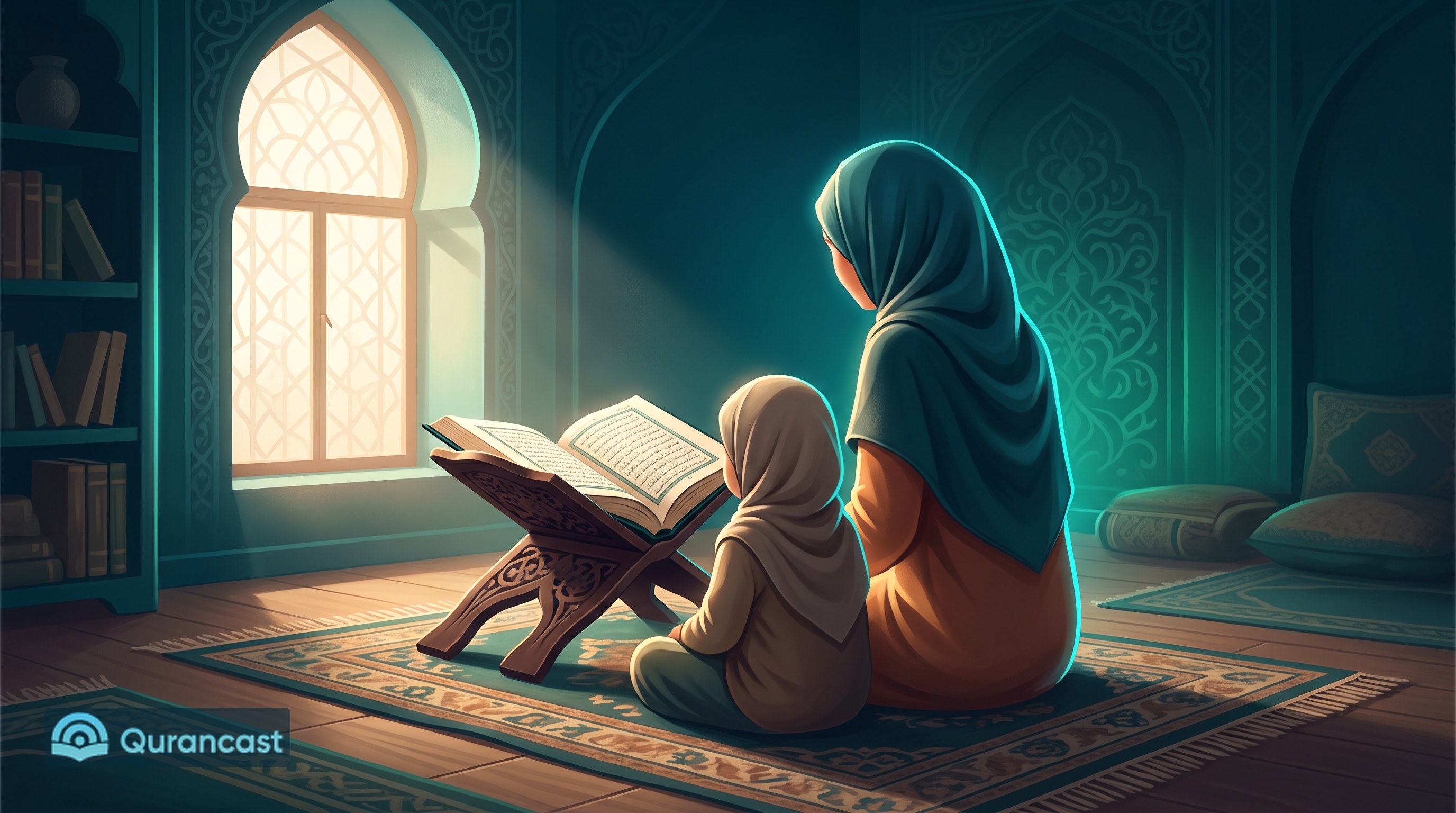
You can teach your child the Quran at home without being a Hafiz or an Arabic scholar. What children actually need is a consistent daily routine, a safe and distraction-free space, short and enjoyable sessions, and accurate feedback on their recitation. Parents provide the love, structure, and encouragement; a qualified teacher — human or a patient AI — provides the Tajweed correction. Here is exactly how to set it up so it lasts.
This guide is written for the parent who wants their child to love the Quran, not just to finish it. It works whether you plan to teach every lesson yourself or use an AI Quran teacher for the live recitation feedback.
Can you really teach your child the Quran at home if you're not a scholar?
Yes — and most Muslim families already do. Teaching a child the Quran at home succeeds or fails on routine and encouragement, not on the parent's own Tajweed level. Your job is to build the habit and the love; accurate correction can come from a teacher, a Qari recording, or an AI teacher that listens and corrects letter by letter. What a child cannot get from an app alone is a parent who sits beside them and makes it matter.
Many parents delay starting because they feel unqualified — "my own Tajweed isn't good enough." That hesitation costs years. A child who reads with a small daily error that gets gently corrected will far outpace a child waiting for the "perfect" teacher arrangement.
At what age should a child start learning the Quran?
There is no single right age, but most families begin with listening and love between ages 3 and 5, then start structured letter recognition around 5 to 7. Before any formal lesson, children absorb the sound of the Quran by hearing it recited at home daily — that familiarity makes the later letter work dramatically easier. Formal reading usually begins once a child can sit for 10 focused minutes.
- Ages 3–5 — ears and heart first. Play short surahs at home and in the car. Let them memorize small surahs by ear, the way they memorize songs. No pressure, no correction — just love of the sound.
- Ages 5–7 — letters and joining. Begin the Arabic alphabet and the harakat (vowel marks). A Qaida (such as Noorani Qaida) is the classic on-ramp. See our guide on going from Noorani Qaida to the Quran.
- Ages 7+ — reading the Mushaf. Move from the Qaida into short surahs from Juz Amma, with Tajweed introduced gently, one rule at a time.
How long should a child's Quran session be?
Shorter than you think. For a young child, 10 to 15 focused minutes a day beats an hour-long weekend class every time. Consistency compounds: fifteen minutes daily is over 90 hours a year. The moment a session becomes a battle, it is too long — end on a win, while the child still wants more.
Anchor the session to something that already happens every day — after Maghrib, right after school, or just before bed. A habit attached to an existing anchor survives busy weeks. (This is the same principle behind building a daily Quran habit that lasts.)
What does a good home Quran session look like?
A simple, repeatable structure removes daily negotiation. A proven 15-minute shape:
- Review (5 min). Recite the last lesson or a memorized surah. Confidence first.
- New lesson (5–7 min). A few new letters, one rule, or a few new ayahs — small enough to succeed today.
- Praise + close (2–3 min). End with specific praise ("your Qalqalah on ق was beautiful") and, if you like, a small sticker or star chart.
Keep the tone warm. The goal of these early years is a child who associates the Quran with a parent's calm attention — not with criticism. Correction matters, but it lands best inside encouragement.
How do you correct Tajweed if your own recitation isn't strong?
This is the real bottleneck for most parents, and it is exactly where technology now helps. You have three honest options, and they combine well:
- A qualified reciter's audio. Play a master Qari's recording of the same ayah and have your child imitate it. Listening to a correct model is half of Tajweed.
- A live online teacher. Even one short weekly class with a qualified teacher gives you a correctness benchmark to reinforce at home.
- An AI teacher that listens. A live AI Quran teacher hears your child recite and corrects Makharij, Madd, Ghunnah, and Qalqalah in real time — patiently, at any hour, without ever getting tired of repetition. This is the piece that was impossible a few years ago and is what makes home teaching genuinely safe now.
QuranCast by NEARFOLD (Dubai) was built for exactly this: a moderated, distraction-free space where a child recites, an AI teacher listens and corrects gently, and parents can see progress without the noise of an open social app.
How do you keep a child motivated without pressure?
Motivation at this age is emotional, not academic. A few principles that work:
- Celebrate effort, not just accuracy. "You sat and tried every day this week" matters more than a perfect letter.
- Use gentle gamification. Streaks, badges, and stars work beautifully when they reward showing up. Keep rewards dignified — crescents, stars, books — not cartoons and noise.
- Never use the Quran as a punishment. "Recite because you misbehaved" teaches the opposite of what you want.
- Let them teach you. A child who "teaches" a parent a surah consolidates it deeply and feels immense pride.
What are the most common mistakes parents make teaching Quran at home?
Most home-teaching problems come from a short list of avoidable habits:
- Sessions that are too long. Turn a joy into a chore and the habit dies.
- Inconsistency. Five days on, two weeks off. Small and daily beats big and occasional.
- Correcting everything at once. Fix one thing per session. Over-correction makes a child afraid to try.
- Skipping the listening stage. Children who hear the Quran daily learn to read it far faster.
- Comparing siblings. Each child's pace is their own; comparison kills love faster than anything.
A simple 4-week starter plan
If you want to begin this week, here is a realistic first month for a 6–7 year old starting letters:
- Week 1: Daily listening to Juz Amma + 10 minutes of letter recognition (5 letters). Goal: enjoyment and routine.
- Week 2: Add the three harakat on those letters (بَ بِ بُ). Goal: read each with Fatha, Kasra, Damma.
- Week 3: Introduce a few more letters; start joining two letters. Goal: read simple two-letter combinations.
- Week 4: Begin a short, familiar surah by ear (e.g. Al-Fatiha or Al-Ikhlas) with correct recitation modeled. Goal: recite along with a teacher or AI.
Slow is fast here. A month that ends with a child asking "is it Quran time yet?" is a bigger success than a month that ends with twenty letters memorized under pressure.
Frequently asked questions
Do I need to be fluent in Arabic to teach my child the Quran?
No. You need consistency and encouragement, not fluency. Accurate recitation feedback can come from a teacher, a Qari recording, or an AI teacher that listens and corrects — your role is to build the daily habit and the love of the Book.
How many days a week should we practice?
Aim for five to seven short sessions a week. Daily practice of 10–15 minutes builds far more fluency than one long weekly session, because children's retention depends on frequency, not duration.
What if my child resists or loses interest?
Shorten the session, increase the praise, and reconnect it to something enjoyable — listening together, a star chart, or reciting to a grandparent. Resistance is almost always a sign the session is too long or too critical, not that the child dislikes the Quran.
When should we add a teacher or an AI teacher?
As soon as your child starts reading actual words and ayahs, accurate feedback matters — mistakes repeated become habits. An AI teacher is available daily for correction; a qualified human teacher is ideal for periodic guidance, even if only weekly.
Ready to make home Quran time calm, consistent, and correctly guided? QuranCast's AI teacher listens to your child recite and gently corrects every letter — free to start, and built to be a safe, distraction-free space for Muslim families. Meet the AI Quran teacher.