Before Ramadan 2027: What an October Review Says About Quran-Learning Apps

A Quran-learning research paper published on 13 October 2026 warns that a usable app, an accurate speech model and a lasting improvement in recitation are different outcomes. For families choosing tools before Ramadan 2027, the practical lesson is to ask what was actually measured, rather than treating every positive technology result as proof of better learning.
News analysis, 30 October 2026. This report draws on the authors’ published abstract and bibliographic page, not an independent reanalysis of the underlying studies. It does not announce the start of Sha’ban, an official Ramadan date or a new QuranCast performance result.
What did the October 2026 Quran-learning paper report?
The paper describes a systematic-review protocol and a provisional map of 23 candidate primary articles found through targeted publisher searches. Its topics include classroom media, mobile memorisation, automated speech feedback and adoption. The authors explicitly say important review procedures remain incomplete, so this is not a completed synthesis establishing which Quran-learning technology works best.
Digital Technologies in Qur’anic Learning: A Systematic Review of Recitation, Memorization, Educational Outcomes, and Implementation appears in the MUDALLA international Arabic-language conference proceedings. The author list includes Abdul Basid and colleagues from Universitas Negeri Malang. Although the title says “systematic review,” the abstract describes a protocol and provisional mapping. That limitation matters more than the label.
Why are app usability and learning improvement different?
Usability asks whether people can operate a tool and find it practical. Learning improvement asks whether their reading, recitation or recall changes in a meaningful way. A learner can enjoy an application without demonstrating better Tajweed, just as an effective lesson can require effort. These outcomes should be reported separately rather than treated as interchangeable evidence.
The authors describe surveys and qualitative studies dealing with motivation, teacher readiness, infrastructure and implementation barriers. Those questions are valuable, but they are not the same as a qualified listener assessing a learner’s recitation over time. A satisfaction score should not silently become a claim of improved articulation.
Does better speech recognition prove better Tajweed teaching?
No. Speech recognition measures how a system identifies spoken material under particular test conditions. Teaching effectiveness concerns what a learner can subsequently do, including skills assessed beyond that system. A model’s recognition result can support an engineering claim without proving that students learned accurate articulation, retained a correction or improved their recitation over time.
The abstract notes that computational papers primarily assess recognition accuracy or word error rates. It does not establish that these measures are useless; it says they answer a different question. Before accepting a broad product claim, ask whether the evaluation measured a model, a user experience or a learner outcome.
What limits prevent stronger conclusions from this review?
The authors report incomplete comprehensive database exports, independent full-text screening and design-sensitive risk-of-bias appraisal. They also say the different outcomes cannot be pooled into a claim of durable learning benefits. Some uncontrolled before-and-after evaluations report short-term score increases, but those observations alone do not establish a lasting effect caused by the technology.
A candidate article is not automatically a study that has passed a full quality assessment. Nor is a list of 23 candidates a pooled experiment involving 23 successful interventions. The paper does not justify a percentage improvement for Quran apps generally, and we do not supply one. Its caution is also not proof that digital tools cannot help.
What should families check before choosing a Ramadan practice app?
Check the learning task, the evidence behind feedback and the way a teacher can review uncertain results. Ask whether claims concern usability, recognition or demonstrated learning, and whether progress was checked after the immediate session. Also consider privacy, cost and access. A useful preparation tool should fit your routine without asking you to trust unsupported promises.
- Task: distinguish reading practice, memorisation review and detailed Tajweed correction.
- Evidence: look for the actual participants, comparison and assessment method behind an improvement claim.
- Follow-up: ask whether a reported gain lasted, rather than appearing only immediately after practice.
- Human support: know where to take a disputed correction.
- Practical fit: review recording policies, connection requirements and the current price before committing.
These are our editorial recommendations, not a validated checklist from the paper. For a broader starting plan, see our Ramadan preparation analysis. Follow your local authority for religious calendar announcements.
How can a learner turn this evidence caution into useful practice?
Choose one skill, practise a manageable passage and arrange a listening check that is not based solely on the app’s own score. Keep a brief record of the correction and revisit it later. This gives you something concrete to discuss with a teacher, while avoiding the assumption that completing a session automatically demonstrates learning.
For example, a teacher can select a passage for distinguishing Idgham with and without ghunnah. Use our Idgham practice guide to understand the categories, then have the actual sound checked. Our recitation-feedback guide explains how to bring a specific question rather than only a score.
Does this research endorse QuranCast or replace qualified teachers?
No endorsement of QuranCast is established by the material reviewed here, and the abstract prioritises expert oversight rather than replacing teachers. QuranCast is the publisher of this analysis and offers AI-assisted practice. That product disclosure is separate from the paper’s findings, which should not be presented as evidence of QuranCast’s effectiveness or superiority.
QuranCast by NEARFOLD (Dubai) provides an AI teacher for recitation practice on the web, with apps on Google Play and the App Store. The takeaway is not to reject technology or adopt it automatically: separate what is convenient, what the software detects and what you have actually learned.
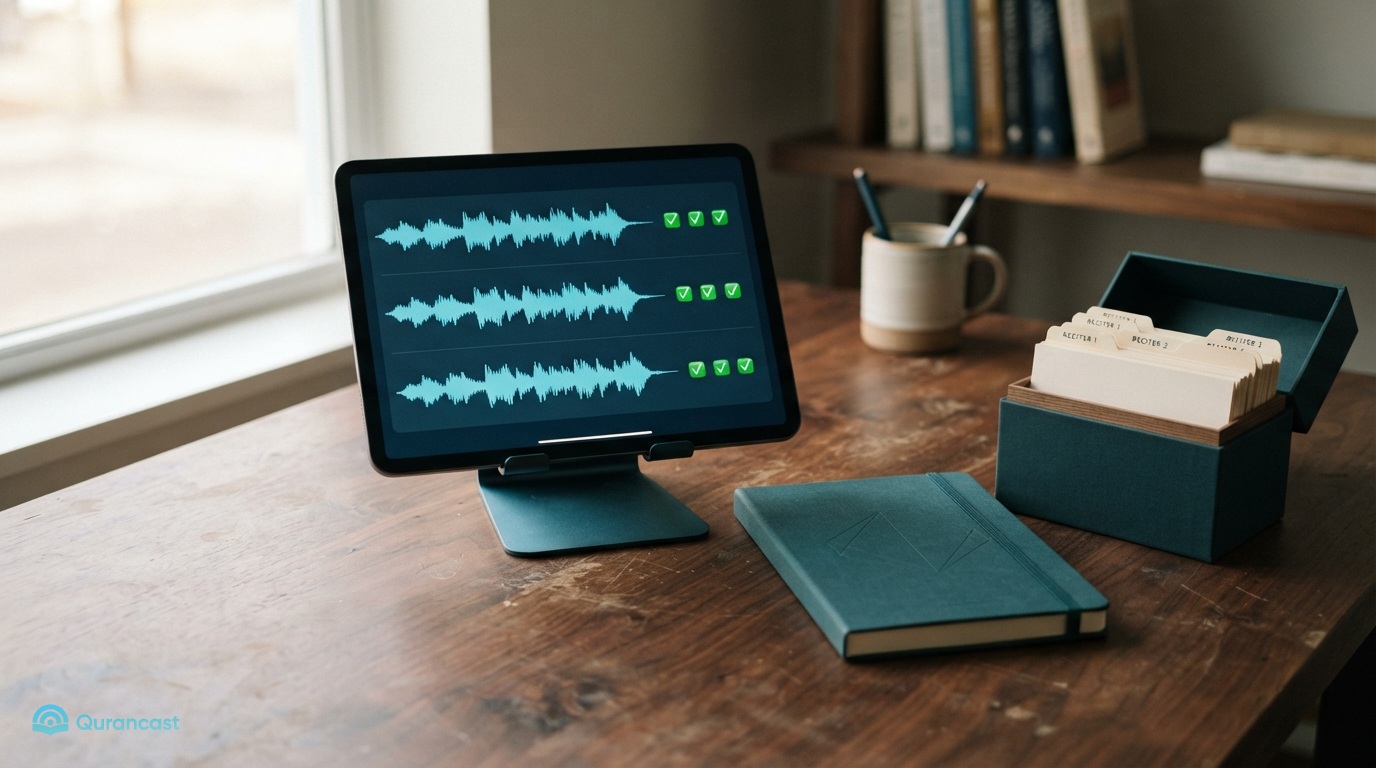
Source: Basid and colleagues, Digital Technologies in Qur’anic Learning, MUDALLA proceedings, published 13 October 2026. Scope: the publisher’s abstract and bibliographic page; underlying study findings were not independently audited. Ramadan and practice recommendations are editorial interpretation. No Quran text is quoted. Cover: AI-generated conceptual illustration, not a photograph of the research or an event, with the official QuranCast logo added separately.