Free vs Paid Quran Apps: What You Actually Get
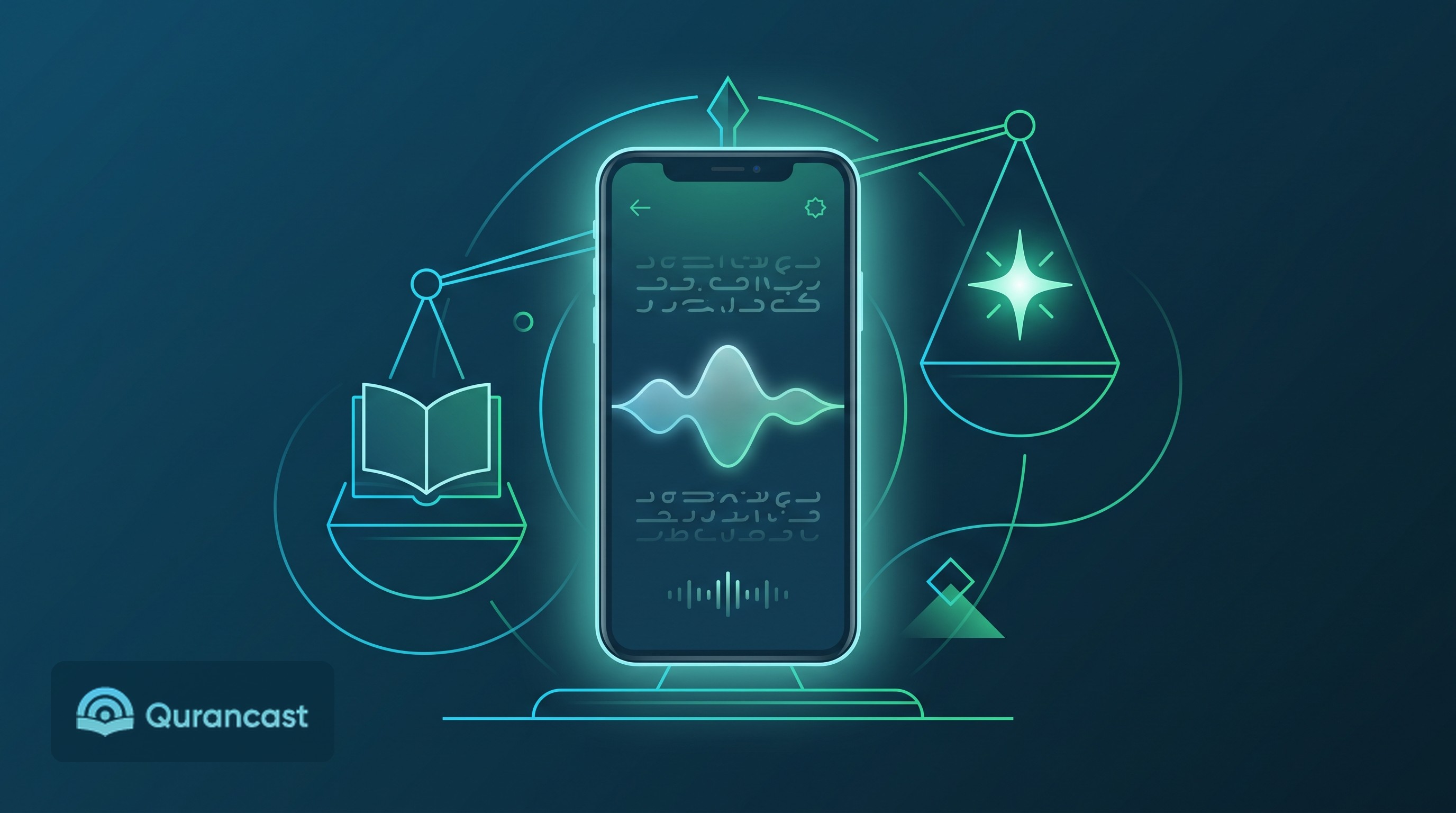
The honest answer is that free and paid Quran apps are not two versions of the same thing — they solve different problems. Free apps are excellent at giving you the Quran to read and hear. Paid apps are built to change how you recite. Choosing between them is less about price and more about what your learning actually needs right now. This piece breaks down what each tier genuinely delivers, where the line sits, and how to decide. QuranCast by NEARFOLD (Dubai) sits on the paid side of that line as an AI Quran teacher that listens and corrects, so we will be transparent about our own position throughout.
What do free Quran apps actually give you?
Free apps reliably deliver the text, translations and audio of the Quran. For reading the mushaf on your phone, following a translation, or listening to a reciter on the go, the free tier across most apps is genuinely good and often enough. If your goal is access to the Quran itself, you do not need to pay anything.
What the free tier usually cannot do is hear you. Reading and listening are input; recitation is output, and output needs a listener who can correct. That single capability — feedback on your own voice — is where free apps almost always stop.
What does paying actually buy?
Paying typically buys correction, structure and measurement. Across the category, the features that move behind a paywall are the ones that respond to you personally: live Tajweed correction as you recite, a structured curriculum that tells you what to learn next, and progress tracking that shows whether you are improving. In other words, you are paying for a teacher's attention, delivered by software.
Where is the real dividing line?
The line is feedback. A free app can show you the rule for Ghunnah; a paid one can tell you that your own Ghunnah was too short. Both have value, but they are different kinds of value. Access to knowledge is now largely free; personalized assessment is what still costs money, because it requires the app to do work on your specific recitation rather than serve the same file to everyone.
Is free ever enough?
Yes — for building a reading habit and for fluent reciters who mainly need a clean mushaf and audio. If you are confident in your Tajweed and simply want the Quran in your pocket, a free app serves you well. The case for paying appears when you are learning to recite, fixing a specific mistake, or memorizing and want to know whether what you are repeating is actually correct.
What should you look for before paying for any Quran app?
- Live recitation feedback, not just lessons — does it listen and correct, or only explain?
- A clear curriculum that meets you at your level instead of a flat library of content.
- Progress you can see — accuracy over time, not just a streak counter.
- Transparent pricing — know whether you are buying minutes, a subscription, or a one-time unlock, and whether unused time expires.
- A genuine free tier so you can test the core experience before spending anything.
How does QuranCast approach the free-vs-paid question?
We made the core teaching experience free to start, and charge only for the minutes the live AI teacher is actually listening. QuranCast's free tier lets you begin reciting and getting corrected at no cost. Paid packages then buy you minutes of live AI-teacher time — you pay for what you use rather than a subscription that ticks whether you open the app or not. The principle behind it is the one this article argues for: reading and listening should be free; the thing worth paying for is a teacher's attention on your own voice. You can try the QuranCast AI teacher and judge the difference between reading about Tajweed and being corrected in it.
The bottom line
Use free apps for access; consider a paid app for correction. The two are complements, not rivals. A sensible setup for most learners is a free app for reading and listening, plus a paid tool for the hours you spend actually reciting and memorizing. Spend where feedback happens — that is where a recitation improves.