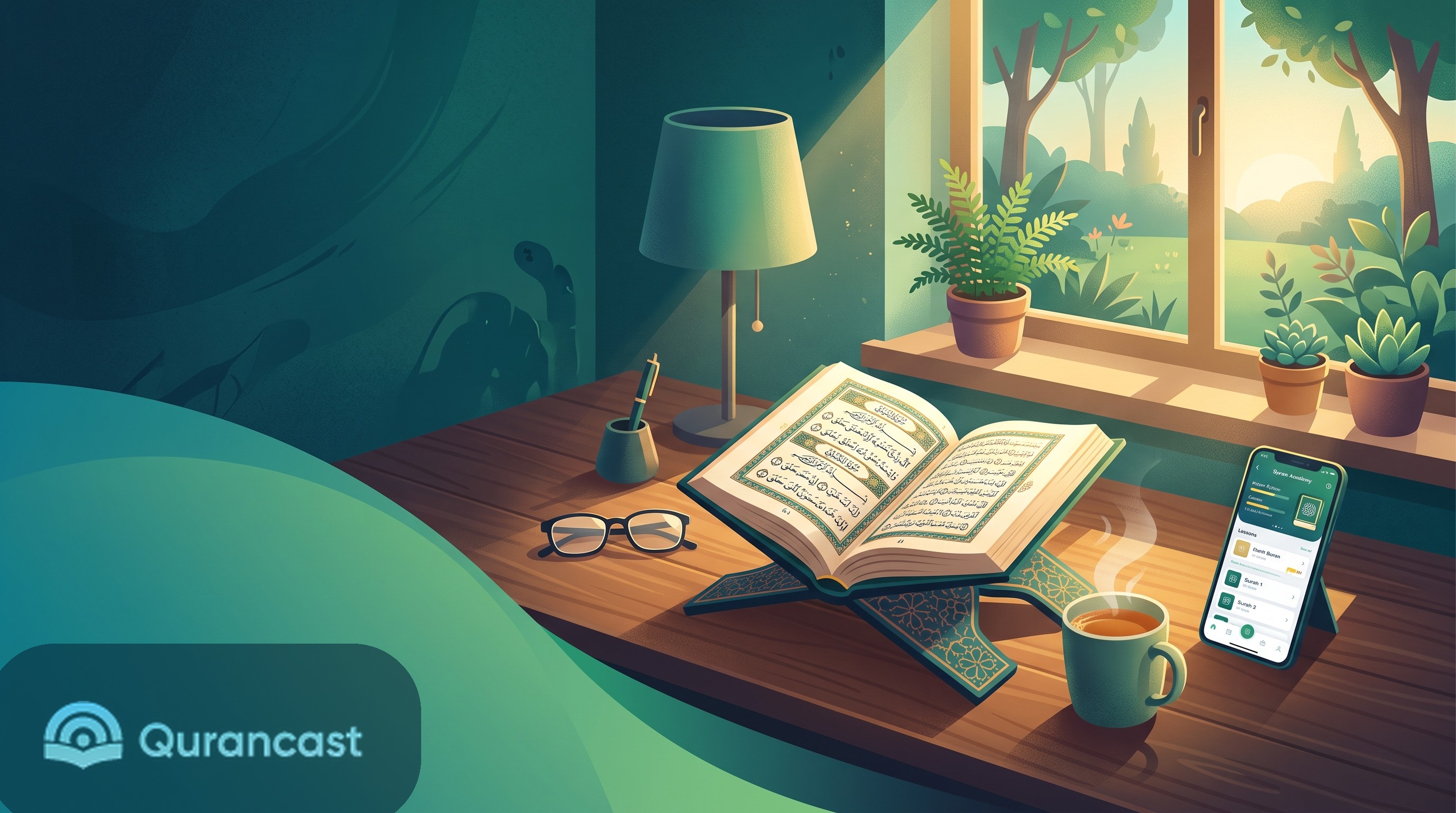
The Spiritual Benefits of Daily Quran Recitation
Muslims have always known that a daily relationship with the Quran steadies the heart — and in 2026 more of the ummah is rebuilding that relationship in small, consistent doses rather than occasional long sittings. The pattern showing up across the community this year is simple: a few ayahs every day, supported by technology that removes the friction, is quietly changing how connected people feel to the Book of Allah.
This is a look at why daily recitation has such a documented effect on the believer's inner life — and how Muslims are structuring their days to actually sustain it.
Why is daily Quran recitation linked to a calmer heart?
Because the Quran itself promises it. Allah says: "الَّذِينَ آمَنُوا وَتَطْمَئِنُّ قُلُوبُهُم بِذِكْرِ اللَّهِ ۗ أَلَا بِذِكْرِ اللَّهِ تَطْمَئِنُّ الْقُلُوبُ" — "Those who believe and whose hearts find rest in the remembrance of Allah; truly, in the remembrance of Allah do hearts find rest" (Surah Ar-Ra'd, 13:28). Recitation is the most direct form of that remembrance. Muslims who keep a daily wird consistently describe the same experience: lower anxiety, more patience, and a sense of being anchored through difficulty.
The key word is daily. The effect Muslims report is tied to regularity — a steady drip of connection — far more than to the length of any single sitting.
What does the Quran and Sunnah say about regular recitation?
The Prophet ﷺ explicitly praised consistency over volume: "The most beloved deeds to Allah are those most consistent, even if small" (agreed upon). The Quran also describes its own role as "a healing and a mercy for the believers" (Surah Al-Isra, 17:82), and promises that those who recite, establish prayer, and give from what Allah provided "hope for a trade that will never perish" (Surah Fatir, 35:29). The recurring theme is a sustained, everyday relationship — not occasional bursts.
Why are so many Muslims returning to daily recitation in 2026?
Two forces are converging this year. First, a widely felt need for stillness: after years of fragmented attention, many Muslims describe the Quran as the one part of the day that quiets everything else. Second, the practical barriers have fallen. Learning to recite correctly no longer requires living near a qualified teacher or affording weekly classes — a live AI Quran teacher can now listen and correct recitation at any hour, which makes a private daily practice realistic for people who previously had no way to check themselves.
That shift matters most for adults and new Muslims, who often avoided daily recitation out of fear of reciting wrongly. When correction becomes private, patient, and always available, the hesitation drops away — and the habit becomes possible.
How are people structuring a daily practice that actually lasts?
The structure that survives busy lives is deliberately small:
- A fixed, tiny amount. A page, five ayahs, or even ten minutes — small enough to do on the worst day, not just the best.
- An anchor. Attached to a moment that already happens — after Fajr, after Maghrib, or before sleep — so the habit needs no willpower to start.
- A way to stay accurate. A teacher, a recording, or an AI listener, so daily repetition builds correct recitation instead of entrenching mistakes.
- A visible streak. Many people keep a simple count of consecutive days; watching the number grow is a quiet, dignified motivation.
This mirrors the habit design we wrote about in how to build a daily Quran habit that actually lasts — the spiritual benefit follows the consistency, and the consistency follows good structure.
Is there a "right" amount to recite each day?
No — and believing there is one is the most common reason people quit. The scholars have long emphasized a sustainable wird over an ambitious one. For someone rebuilding the habit, a few ayahs recited correctly and reflectively every single day carries more lasting benefit than a juz read once and abandoned. The best daily amount is the one you will still be doing in a year.
What changed to make daily recitation easier to sustain now?
The honest answer is that the spiritual value never changed — only the access did. The barriers that used to break a daily practice were practical: no teacher nearby, no one to correct mistakes, no structure to keep going. Those are precisely the barriers technology has now lowered. QuranCast by NEARFOLD (Dubai), for example, was built around the idea that a Muslim anywhere should be able to open the app, recite, be gently corrected by an AI teacher, and keep a daily streak — in a safe, moderated, distraction-free space.
The result is that "I don't have a teacher" and "I'm afraid of reciting wrongly" are no longer reasons to postpone a daily relationship with the Quran. What remains is the oldest and simplest step: begin today, with a small amount, and do it again tomorrow.
Start your daily recitation with a teacher who is always patient and always available. Recite with the QuranCast AI teacher — free to begin.